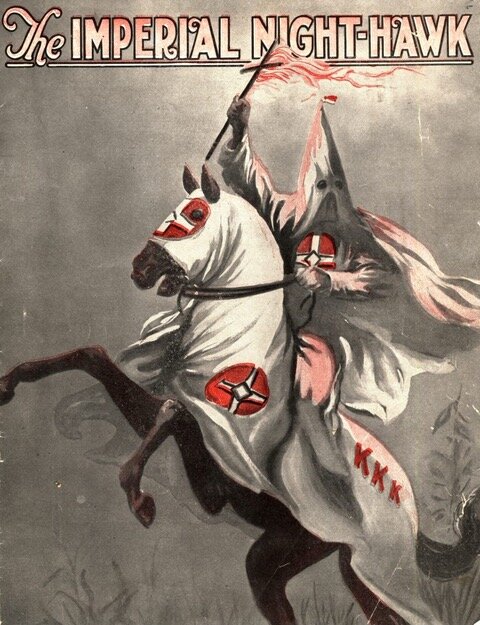
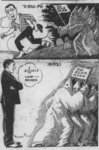
At 6:30 p.m. on May 12, Nancy Vaillancourt will be bringing her presentation, “Hooded History” to the West Concord Public Library. Co-sponsored by the West Concord Historical Society, Nancy will talk about what her research has revealed about the Klu Klux Klan’s presence in southeast Minnesota in the 1920’s,
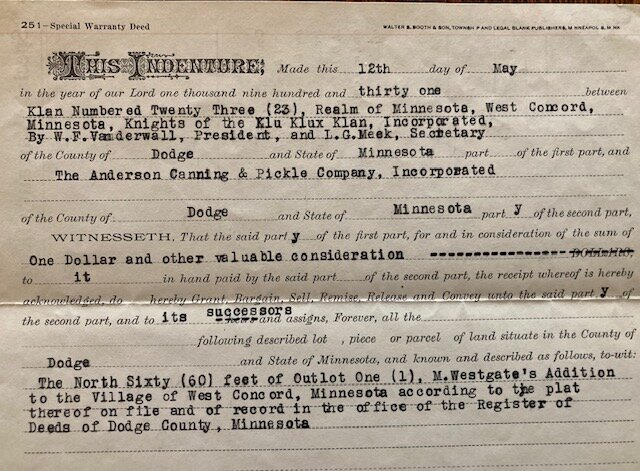
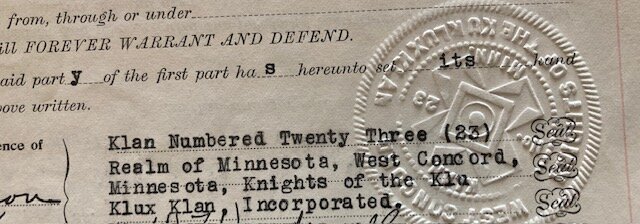
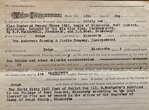
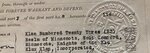
Our first reaction to learning about Nancy’s program might be, “Hmmm, that could be interesting, but of course, it will have nothing to do with our West Concord.” We need to stop right there. Our Museum holds the original deed with which Klan Numbered 23, Realm of Minnesota, West Concord, Minnesota, Knights of the Klu Klux Klan Incorporated, purchased the North 60 feet of Outlet One (1), Westgate’s Addition to the Village of West Concord on November 21, 1927. This is the property on East South Street that would later become the home of the Northfield Milk Plant. The Klan held that property for three and a half years and in May of 1931 sold the property to Anderson Canning and Pickle Company of Dodge Center.
If the Klan was active in West Concord in the 1920’s, did the West Concord Enterprise ever mention it? The front page of the August 30, 1923 Enterprise led with this article: “‘Klu Klux Klan Lectured on the Street Saturday”. The column explained that West Concord residents awoke to find an advertisement in almost every tree in town announcing that the editor of the KKK’s weekly newspaper, “Call of the North”, was going to give a free lecture on Main Street that very evening. The Enterprise editor said townspeople were very curious about the event. The Enterprise itself made a point to be there early to interview the speaker because “we had never come in contact with members of this organization and had heard much about their methods that didn’t appeal to us.” The following are some of the questions the Enterprise asked:
“How did you happen to come to West Concord to lecture?” “I came here by invitation of Klansmen of your village”, Mr. Orn replied.
“Are there members of your organization here?” “Yes, and in almost every other town in Minnesota,” he answered.
“Why did you put your bills up in town after dark on Friday night? It looked to many as though you were ashamed to do it in broad daylight.” “Nonsense,” replied Mr. Orn. “My advance man was requested to bill West Concord for the lecture. He came from Owatonna and must have got here late. No other town that I know of has ever been billed in the night, and upon my return I shall find out how it happened.”
“What is the membership of the Klu Klux Klan at the present time in the United States?” “More than 6,000,000.”
“What are you organized for?” Mr. Orn answered, “For white supremacy—we are opposed to the intermarriage of whites and blacks. The protection of pure womanhood. The separation of church and state. Upholding the constitution of the United States. Standing strongly for the public school, which we believe to be the rock of the American government.”
The band had stopped playing and it was now time for Mr. Orn to speak. Even though it was raining, the Enterprise remarked that “quite a crowd” stayed to hear the speaker who “received a very courteous hearing from all present.”
The July 17, 1924 Enterprise reported that a national KKK lecturer came to town and spoke to West Concord citizens from the bandstand following the Saturday night band concert. The editor noticed that many people picked up membership applications that night. “It is reported that the membership of this organization in this vicinity is somewhere around one hundred and fifty.”
One event that the West Concord Enterprise did not cover, but both the Kenyon and Mantorville newspapers did, was what happened at the Concord Church on a Sunday evening in September of 1924. Reverend M.B. Meeks had just preached a sermon entitled, “One Hundred Percent Americanism” and the congregation was singing the closing hymn, “Onward Christian Soldiers”. Suddenly the front door opened and in marched over twenty Klu Klux Klan members dressed in their robes, but not hooded, and carrying an American flag. When the hymn finished the leader walked to the pulpit and gave Rev. Meeks an envelope of money, a gift from the Dodge County Klu Klux Klan. The leader obtained permission to talk to the congregation for a few minutes, explaining KKK ideals and goals and answering questions. Then, the Kenyon News reported, “the Klansmen marched out of the church and disappeared as mysteriously as they appeared.” The Kenyon article also mentioned that the KKK “burned a mammoth fiery cross after the fireworks” at the Dodge County Fair that week.
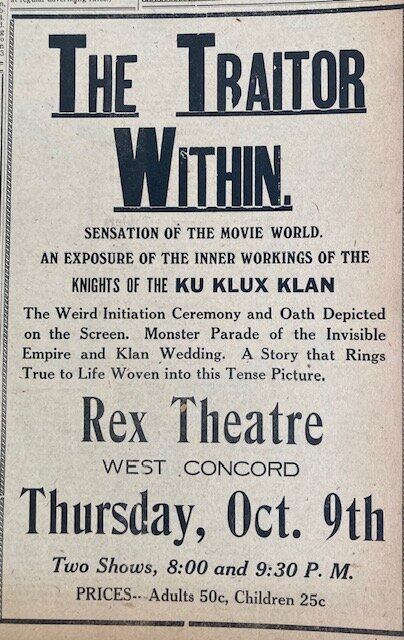
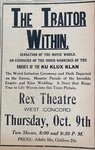
In October of 1924 West Concord’s Rex Theater presented two showings of the KKK propaganda film, “The Traitor Within”, one of the two movies that the KKK created to inform the broader audience of their ideals. The following weekend was “Community Days” in West Concord. As the band was playing their concert about 50 robed members of the Klan paraded Main Street and passed out literature. After the concert was over “quite a speech” was made from the bandstand by one of the KKK members. It was thought that those parading came from Rochester and Owatonna, as they were unknown to most people in town.
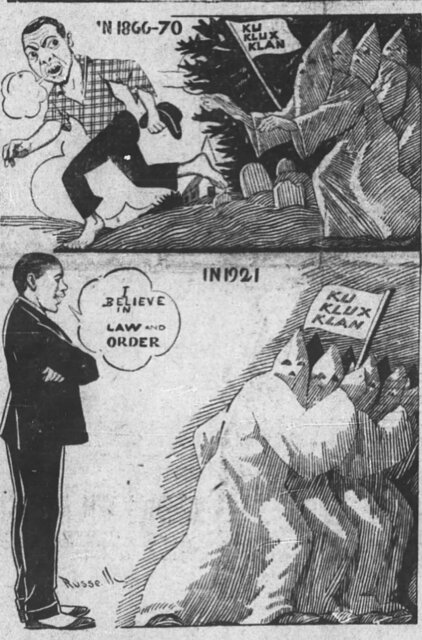
What were some of the themes beyond white-supremacy in the KKK’s resurgence in the 1920’s? Anti-immigrant, anti-Catholic, anti-alcohol, and anti-Semitic ideals were promoted. According to an article in the December 4, 2016 Atlantic magazine, the KKK “packaged its noxious ideology as traditional small town values and wholesome fun. Native born white Americans were led to believe that bigotry, intimidation, harassment and extralegal violence were all perfectly compatible with, if not central to, patriotic responsibility.”
What led to the demise of the KKK comeback in the 1920’s, also known as the “second wave”? One shock to the KKK’s system came when national KKK leader, D.C. Stephenson was found guilty of murder in 1925 after savagely raping a young woman. That many of the Klan’s fear mongering predictions didn’t come true was also a factor. The onset of the depression quieted the movement, too. The KKK would return for a third wave from 1954 through the mid-60’s when the Civil Rights Movement was in full swing. Today U.S. KKK membership is under 5,000, but sadly there are many other “hate” groups in our country. Our hope lies in the words of Dr. Martin Luther King:
“I have decided to stick with love. Hate is too great a burden to bear.”