

Mark Twain once said “Continuous improvement is better than delayed perfection.”
When G.W. Priest of Dodge Center bought West Concord’s faltering Tile Plant for $21,200 in April of 1913 that might be what he had in mind. He moved to West Concord in May and hired eight men to begin operation at once. Wm. Newman was hired as foreman. That first year was successful according to the Enterprise. Then no mention was made of the Tile Plant until August 20, 1914 when it was announced that machinery breakage at the plant had shut it down until fixed. There was not a single word about the Tile Plant in 1915 or 1916, until November of 1916 when “parties came to town from Mason City and Minneapolis looking over the plant with intent to purchase.” They would be the third owners of the Tile plant.
It was a “done” deal, and the plant was reorganized under the leadership of a D.G. Donohue who had practical knowledge about earth materials from his attendance at the Michigan College of Mines, W.G. Lowrey who was a well-known promoter and financier, and J.J. Jones who was financial secretary of the Minneapolis Bricklayers’ Union #2. All three gentlemen were from Minneapolis and the main office for the West Concord operation was established there at 6th and Hennepin, with another office to be built at the brickyards. The Enterprise never tired of boosting the business. In December they reported, “The new brick and tile plant will run to its full capacity and employ more than 30 hands. Let’s talk about how our town grows. Be a booster! Get out of the rut! Smile!”
The new ownership had big plans. They wanted to build 4 new modern kilns and purchase a new drying system so that the products could be bone dry in 24 hours.
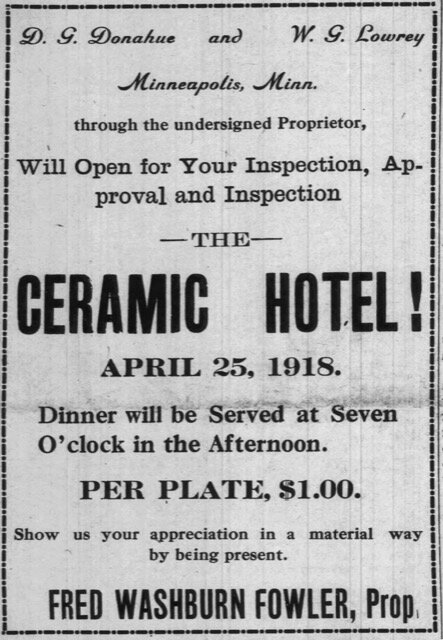
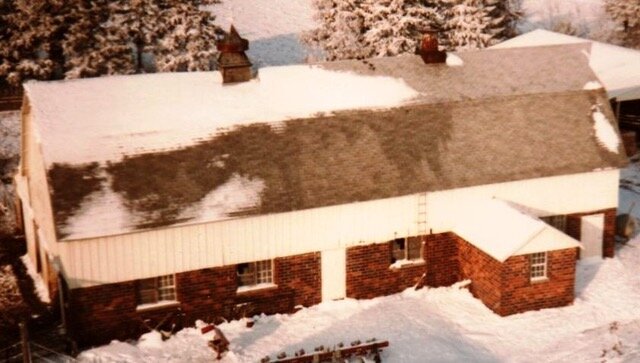
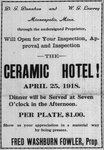
In March of 1917 it was announced that the company had purchased West Concord’s old flour mill and was converting it into a 15-room hotel with hot water bathrooms for its employees. It was named the Ceramic Hotel. The Enterprise scolded the community again, “West Concord does not seem to realize the magnitude of the work being done but soon brick and tile will be manufactured here on an extensive scale.”
In July of 1917 the new owners held a meeting at the Opera House to inform the town of their plans for the plant. So far, they had spent $10,000 in improving it. That would be about $250,000 in today’s dollars—quite a chunk of change. Here are the Enterprises comments after that meeting: “Mr. Lowrey expects the people of West Concord not to invest, but to quit knocking and work for the interests of their hometown. If you can’t boost, keep quiet, but for heaven’s sake quit running down the home enterprises that will eventually do much to advance the prosperity of our town.” There must have been a group of naysayers in town. By November of 1917 twenty-two men were employed at the plant.
May 2, 1918 was the official opening of the Ceramic Hotel on south Front Street. The Enterprise reported that 162 people enjoyed a “sumptuous” three-course dinner in the dining room, with seatings of 50 guests at a time. An orchestra from Minneapolis provided music and guests were given tours of the new hotel. The general consensus was that it was a “cozy” place. What a night in West Concord! Following the Ceramic Hotel dinner, guests moved to City Hall for dancing followed by a “dainty” midnight oyster supper. Quite an extravaganza!
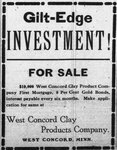
In November of 1918 new articles of incorporation for the plant were published in the Enterprise. The plant now had a new name: The West Concord Clay Products Co.
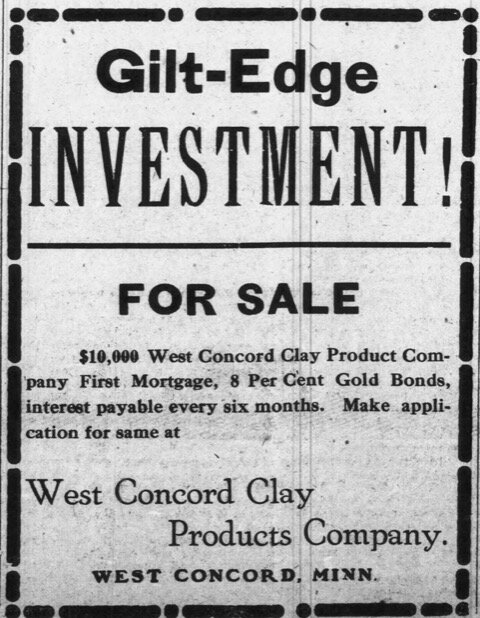
Its debt limit had been raised to $35,000.
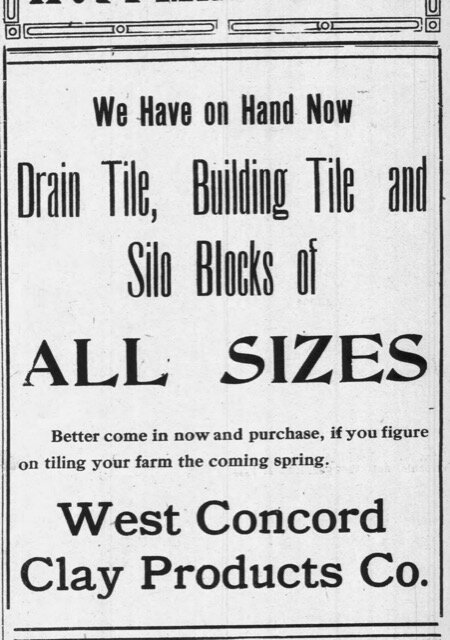
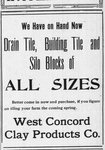
1919 was a booming year for the plant. In August seven railroad cars of building blocks were shipped in four days, and it was reported that the plant had enough orders to fill 17 railroad cars with drain tile. That would keep the employees busy for seven weeks. In September the Enterprise editors toured the plant. They reported that the 20 employees were not able to fill all the orders they had from Minnesota and other states. The plant was turning out 5000 double building blocks per day and selling them for $65 per thousand. They were producing 30,000 brick per day and selling them for $17 per thousand. Silo blocks were being sold at $75 per thousand and various sized drain tile was selling from $27.50 to $152.50 per thousand. The plant now had 12 drying tunnels that could handle 18,000 double building blocks each, as well as 6 kilns. The monthly payroll was $1800. It all sounded so promising with the Enterprise editorializing, and likely exaggerating too, “No better brick and tile is manufactured in this country and the demand for it proves this to be a fact.”
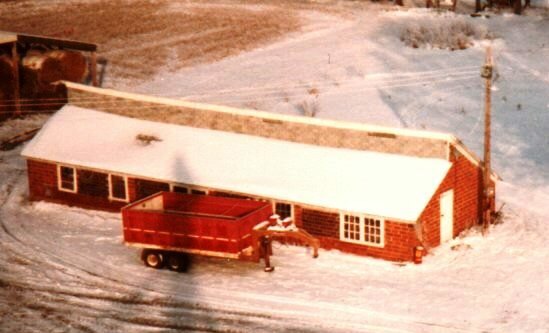
So, what happened? Why didn’t the WC Clay Products Co. make it? We really don’t know because the Enterprise didn’t mention the Tile Plant between 1922 and 1929. We know there had been some accidents at the tile plant. None were fatal, but some were serious. Most likely the debt load had a lot to do with its demise—overbuilding and overextending. By 1929 the Company was once again referred to as the “old tile factory plant”. Two gentlemen, Hoffman and Larson, were selling the brick, tile, building blocks, silo blocks, and cement that remained at the old plant.
By the early 30’s both the Boy Scouts and the Legion were making efforts to fix up the tile plant pond for safe swimming for West Concord kids. Citizens were admonished, “Anyone using the pond does so at their own risk and should have a responsible chaperone with them.” In July 1936 the Enterprise reported that the “pool at the tile plant is much in use these hot days and could be made into a pretty tourist park with some work.” By 1943 the owner of the tile plant property then, Roy Bringgold, asked people not to trespass any more. It was simply too dangerous and could result in serious trouble. He posted notice in the newspaper that he was not liable for any injury or death at the tile plant pond and that trespassing was not allowed.
Now you know the rest of the story—the rise and fall of the old Tile Plant. All that remains is the pond, south of Gochnauer’s dairy barn. But we should keep in mind what Thomas Edison said, “I have not failed. I’ve just found 10,000 ways that won’t work.” Perhaps that’s what happened in West Concord.
Merry Christmas to all!