When I was a child I loved visiting my grandparents at their home on Olive Street in West Concord. I often rewind and play back those memories just because they make me smile.
The other day it occurred to me that my grandma always asked me to get
food from her “icebox”. I never heard her say the word “refrigerator”. I thought about it for a while and realized that for the majority of her life an icebox was exactly what grandma had. That would be her name forever for anything that kept food cold.
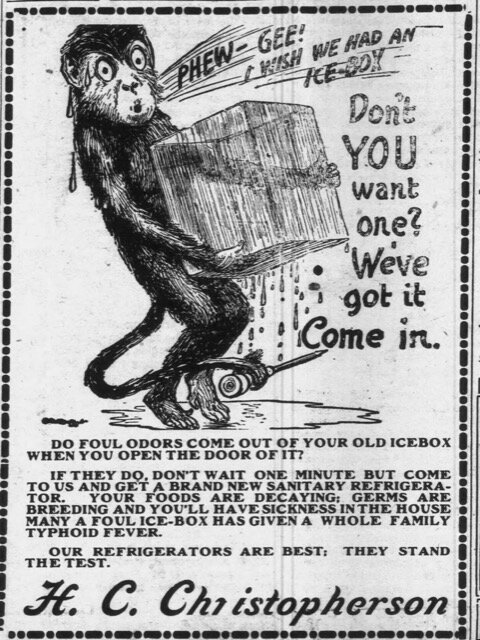
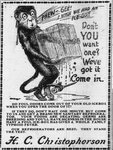
In West Concord, from the time the town was founded in 1885, until the 1930’s, ice boxes were what kept food fresh and safe in most households. The early West Concord newspapers are filled with tips for keeping home iceboxes sanitary, A 1905 Enterprise advised keeping the icebox “sweet and clean” by burning in it a small disinfecting candle. Be sure to leave the doors open to air it.” To keep ants away it was recommended to “tie a string saturated with turpentine around each leg of the icebox.”
The Department of Agriculture’s Food Safety Bulletins were frequently published in the Enterprise those days. Infant deaths were all too common and one of the reasons given in the 1910 Ag Bulletin was that milk was left to stand for hours in a warm room.
To remedy the unsafe situation the Bulletin recommended making a small milk refrigerator following the steps they provided:
“Obtain a wooden box from the grocer at least a foot deep. Buy a tin pail with a cover, deep enough to hold a quart bottle of milk. Buy a slightly bigger pail without a cover. Put the pails one inside the other into the center of the box and pack sawdust or excelsior (curly wood shavings) beneath and around. Nail 50 layers of newspaper to the under surface of the box cover. Each morning fresh milk should be put in the pail and 5 cents worth of ice should be cracked and put around the milk bottle and the cover put back on. Finally, put the lid on the box. Every morning pour the melted ice off.”
In 1924 the Ag Bulletin admonished icebox users to make sure the iceboxes were well insulated with only clean ice, clean food, clean containers, and were wiped clean each day. Consumers were urged to use a thermometer to make sure the ice box was at 50 degrees or less. That seems a little warm to me for refrigeration by today’s standards. Remembering to empty the pan of melted water under the icebox was a regular duty. If forgotten, you’d soon be reminded by water running across the floor.
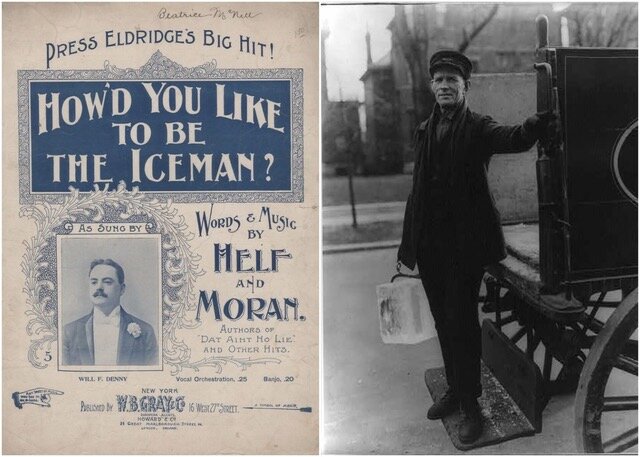
How did households get their ice when they needed it? Residents put a card in the window of their homes telling the iceman how many pounds of ice they needed and he brought it to them on his delivery route. Typical cost for ice ran somewhere between 25 to 40 cents per 100 lbs. of ice but a small chunk of ice for daily use could be had for a nickel.
The iceman was so much a part of daily life that popular songs were even written about him. Two popular songs hinted at the chances the iceman had to get to know the women on his route—much like mailman innuendos in later years. In 1899 the song, “How’d You Like to Be the Iceman?” was popular and in 1907 “All She Gets From the Iceman is Ice” was a hit.
Little anecdotes about the iceman were found throughout the early West Concord newspapers. Here’s one:
“Are you getting ready for winter?
Yes, we’ve had our last scrap with the ice man and have begun to quarrel with the coal man.”
And this: “Worry won’t make the iceman give you a bit bigger chunk.”
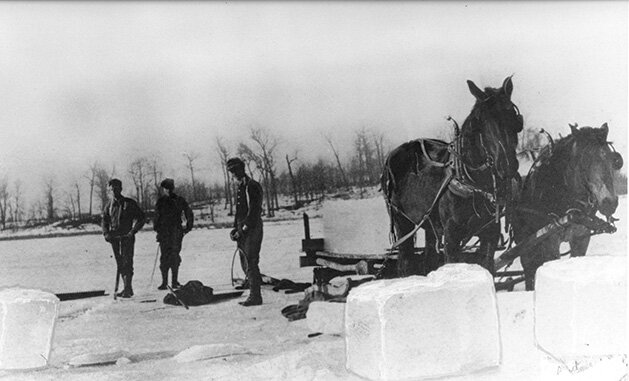
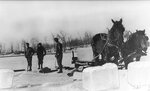
Where did all this ice come from? Ice harvesting was a serious job every winter in January and February. Ice was cut on lakes, rivers, creeks, and ponds and stored in ice houses, usually with thick wooden walls, and insulated with sawdust, hay, and straw.
Ice kept this way would last for nearly a year. Farms had their own icehouses, as well as root cellars, to keep food and milk cool.
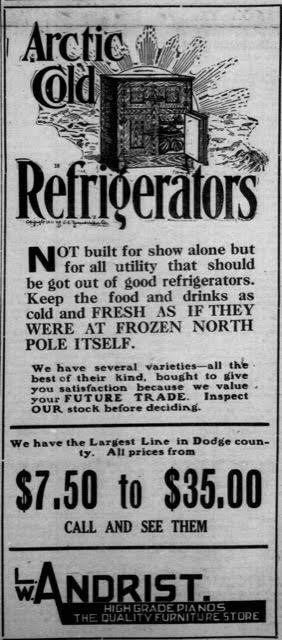
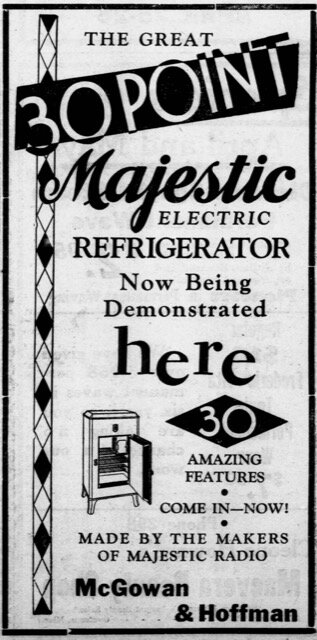
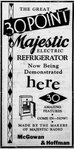
It wasn’t until 1927 that electric refrigerators were first advertised for sale in West Concord newspapers. General Motors advertised the Frigidaire and Northern States Power Company advertised the Kelvinator. By 1930 Frank Griffin was selling electric refrigerators and by 1935 Ferguson and Son were stocking them, too. Those vintage refrigerators became famous for their longevity. They often lasted for decades.
We knew times had really changed when the Enterprise wrote, “Our idea of a real
vacation is an electric refrigerator, a couple of electric fans, the latest mystery, and a comfortable seat on a shady front porch.”
The icebox was relegated to history and life became simpler in yet another way.
As the Enterprise wrote in 1931, “Look back 30 years. How many of you boasted of an electric refrigerator, an auto, a radio or a paved street by your house?” The Enterprise also asked, “How many of you would give those things up?” I’m sure we know the answer to that question.